
Product
January 12, 2024
Data investments rarely fail all at once. More often, dashboards lose relevance, definitions drift, and usage slowly declines. Here’s how treating analytics like products can keep them useful long after launch.
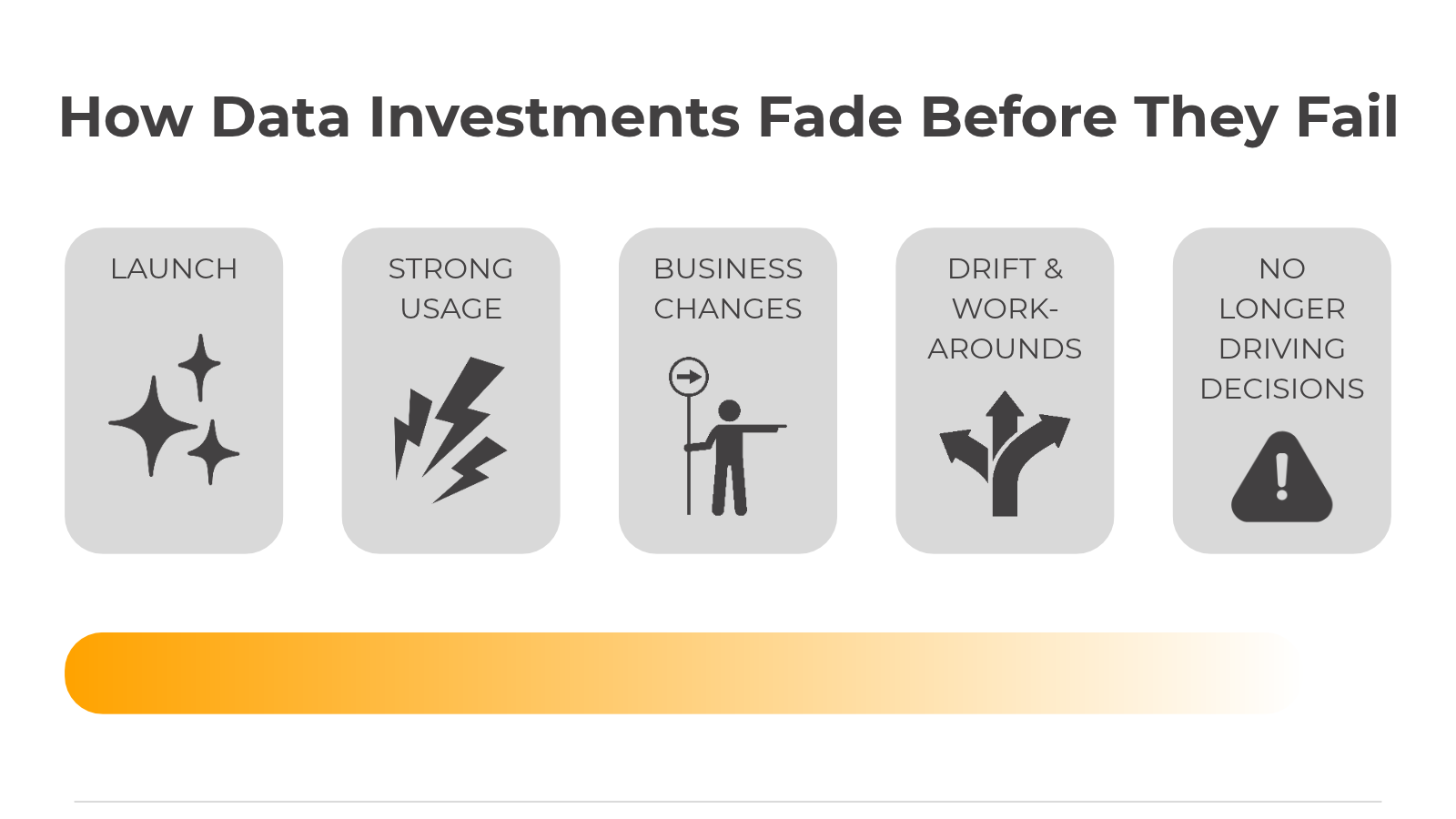
Data investments rarely fail in one dramatic moment.
More often, they fade.
A dashboard launches with plenty of attention. A reporting process gets automated. A new platform gives leaders access to information they could not easily see before. For a while, people use it and trust it.
Then the business changes.
Priorities shift. Definitions evolve. New source systems appear. The people who originally requested the solution move into different roles. Small quality issues build up. Users create workarounds because changing the official product feels harder than solving the problem themselves.
Eventually, the dashboard still exists, the pipeline still runs, and the organization is still paying to maintain it.
It just is not shaping decisions the way it used to.
That gradual decline is what makes data decay easy to miss.
There may never be a major outage or a single moment when everyone agrees that a dashboard has failed. Instead, usage slowly drops. Trust weakens. Documentation falls behind. A spreadsheet starts circulating alongside the official report.
By the time the problem becomes obvious, the organization may be supporting an analytical product that stopped being valuable months ago.
The better question is not simply whether an analytical product still works.
It is whether the business still relies on it.
Analytics products tend to remain useful when a real business decision depends on them.
That relationship can be surprisingly simple:
Metric → Decision → Owner
The metric provides the evidence. The decision gives that evidence a purpose. The owner is responsible for interpreting what changed and deciding what to do about it.
Without that connection, a dashboard may still contain useful information, but it becomes easier for the business to ignore.
Before building or expanding an analytical product, teams should understand what decision it supports, who makes that decision, how often it happens, and what is expected to change when the metric moves.
Dashboards do not create accountability by themselves. Ownership does.
If nobody's decision depends on the product, its relevance will eventually fade.
Organizations are usually comfortable funding visible outputs.
New dashboards are visible. Platform launches are visible. New AI capabilities are visible.
The quieter maintenance work receives less attention, even though it is often what keeps those visible products dependable.
That includes reconciliation between systems, documentation, data-quality checks, consistent schemas, lineage, monitoring, and clear definitions.
When that work falls behind, the symptoms show up gradually.
Numbers begin to disagree. Teams forget why a calculation was designed a certain way. Business users discover quality problems before the data team does. Small source-system changes create unexpected downstream issues.
None of this makes for an exciting product demo.
It is still the data work that keeps the product usable.
Many data initiatives are still managed like conventional projects.
They have a start date, a defined scope, a launch, and a moment when the work is considered complete.
The problem is that the business does not stop changing after launch.
A dashboard is not permanently relevant because it was useful when it shipped. A data model is not permanently correct because it passed validation once. Definitions, users, source systems, and business priorities continue to change.
Analytics needs an operating model that can change with them.
That usually means smaller, regular improvements instead of waiting for another major redesign. Teams can review usage, check data quality, revisit business priorities, collect feedback, update documentation, and make a few high-value changes while the context is still fresh.
Over time, those small releases compound.
The goal is not to finish the data product.
The goal is to keep it useful.
Usage is one of the clearest signs that an analytical product may be drifting away from the business.
A decline does not automatically mean the product should be removed. It does mean someone should ask why.
Maybe the dashboard no longer supports an important decision. Maybe users stopped trusting the numbers. Maybe the workflow changed, another source became easier to use, or the original owner is no longer engaged.
Sometimes the product has simply been replaced by something better.
Instead of treating declining usage as a failure metric, teams can treat it as a prompt for investigation:
Who still uses this? What decision are they making with it? What value does it provide that another product does not? What would actually happen if it disappeared?
If those questions become difficult to answer, continued maintenance deserves a closer look.
Organizations tend to create dashboards much faster than they retire them.
Over time, that produces an analytical estate full of overlapping reports, outdated definitions, unclear ownership, and different answers to the same business question.
Keeping everything does not preserve value. Eventually, it creates noise.
If a decision has changed, the product may need to change with it. If another dashboard has replaced it, the duplicate can go. If nobody owns it and nobody would miss it next month, continuing to maintain it may not be worth the effort.
Retirement is not an admission that the original investment failed.
Sometimes retiring an old product is evidence that the organization is actively managing its analytics instead of simply accumulating them.
A durable analytical product needs more than someone who can keep the pipeline running.
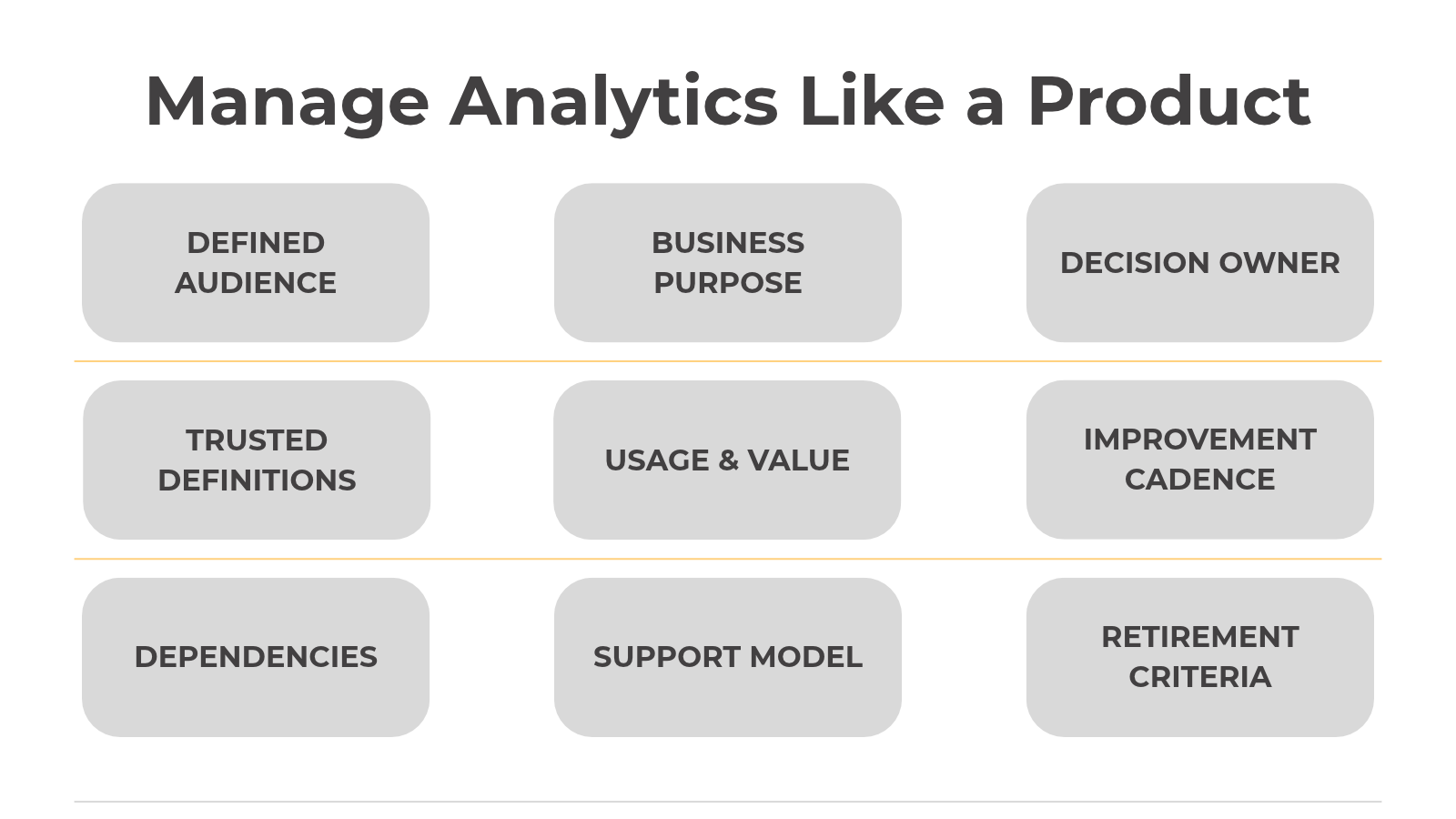
It needs a defined audience, a business purpose, clear ownership, trusted definitions, a way to measure usage and value, and a plan for continued improvement.
It also needs maintenance, documented dependencies, and a clear point at which the organization is willing to retire it.
That mindset changes the question from:
"Did we deliver the dashboard?"
to:
"Is this still helping the business make a better decision?"
That is a much harder standard, but it is also a much more useful one.
Keeping analytics relevant does not require constantly rebuilding everything.
A simple recurring rhythm is often enough.
Monthly reviews can focus on usage, reliability, quality issues, and small improvements. Quarterly reviews can reconnect products to current decisions, owners, and definitions. A couple of times each year, teams can look across the broader portfolio for duplication, low usage, and outdated products.
Then, periodically, the organization can step back and examine the foundation itself: architecture, documentation, reconciliation, quality controls, delivery processes, and team capacity.
The exact cadence will vary by organization.
What matters is that somebody comes back to the product after launch.
Without that rhythm, drift is almost inevitable.
Data investments do not stay valuable simply because they were valuable when they launched.
They have to be operated.
Connect each analytical product to a real decision and give that decision an owner. Fund the foundational work that keeps the data trustworthy. work to improve the product in manageable increments. Be sure to watch how people actually use it, and retire it when it no longer supports meaningful action.
Treat data like an operating system, not a project.
Projects reach an endpoint.
Strong data capabilities keep adapting.
Interested in building a data capability that stays useful long after launch?

At NexusLeap, we’re united by a singular mission: equip our clients with decision-making analytical tools.


Facilitates seamless business operations.
Copyright © 2024 by NexusLeap, LLC.