Tutorials
January 12, 2024
AI readiness is about more than choosing the right tools. Learn how clear ownership, trustworthy decision data, and continuous delivery help organizations turn practical AI experiments into measurable, scalable business value.
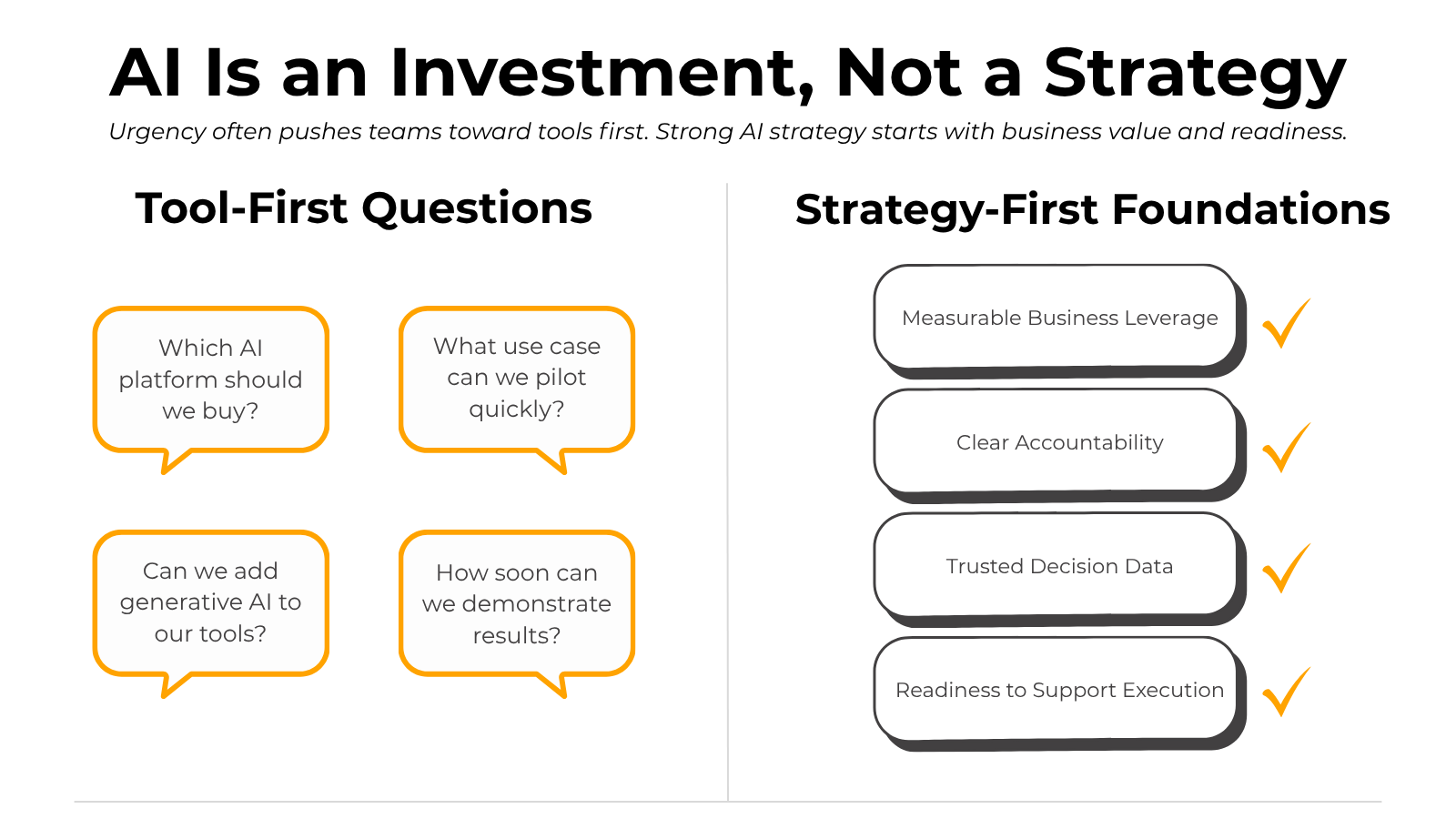
AI investment often starts with a technology conversation.
Which platform should we buy? What use case can we pilot quickly? Where can generative AI fit into the tools we already have?
Those questions matter, but they are downstream questions. Before deciding how to use AI, organizations need to know where it can create meaningful leverage — and whether the data and operating model beneath that use case are ready to support it.
That does not mean waiting for perfect data or a multi-year transformation. It means having enough ownership, trust, and delivery discipline that an AI investment can produce something more durable than an interesting demo.
When those foundations are in place, AI becomes easier to evaluate, safer to scale, and far more likely to create measurable business value.
Most organizations do not need to pause AI experimentation until every data problem is solved. But certain patterns are strong signals that scaling investment too quickly will create more friction than value.
Metrics may exist, but accountability does not.
Every review becomes a debate about definitions, responsibility, or whose calculation is correct. Teams may contribute to a metric, but no one has clear authority to resolve conflicts or act when performance changes.
Without ownership, data informs discussion but rarely drives execution.
Different dashboards, departments, or meetings produce different numbers for the same business question.
Teams spend time reconciling reports rather than making decisions. Confidence declines, and leaders begin relying on personal judgment or manually assembled spreadsheets instead of shared analytical products.
If the dashboards are not trusted, AI-generated recommendations built on the same data will not be trusted either.
Dashboards refresh. Reports are distributed. Analysts respond to frequent requests.
Yet the decisions remain largely unchanged.
This is activity without action. It suggests that reporting has become disconnected from business outcomes, operational levers, or accountable owners.
Adding AI may make the reporting process faster, but it will not automatically make the information more consequential.
Small updates break downstream reports. Timelines slip without a clear explanation. Teams hesitate to modify definitions, pipelines, or analytical products because they cannot predict what else will be affected.
This makes AI particularly difficult to scale. Early experimentation may be possible, but moving from a pilot to a dependable capability requires a foundation that can evolve safely.
These are not primarily tool problems. They are signs that the operating foundation is not yet strong enough to support acceleration.
Before increasing investment, organizations should assess three areas.
Readiness starts with knowing who is responsible for the data and decisions behind the use case.
Ownership does not mean one person performs every technical task. It means there is someone with enough authority to define what “correct” means, coordinate contributors, resolve ambiguity, and make tradeoffs when priorities or quality issues emerge.
Without that clarity, even good data tends to stall in discussion. Metrics exist, dashboards exist, and teams contribute — but nobody has clear authority to act when something changes.
AI does not solve that ambiguity. It simply introduces another layer of output that still needs someone to interpret, trust, and own.
No ownership → no decisions → no progress.
The second foundation is trustworthy decision data.
That does not mean every dataset in the organization needs to be perfectly cleansed. It means the data involved in a specific AI-supported decision is understood well enough that leaders know where it came from, how it was defined, and what limitations it carries.
Consistent definitions, known lineage, reliable quality checks, reconciled metrics, and appropriate governance all contribute to that trust. When those pieces are missing, AI may still produce an answer — but the organization has little reason to rely on it.
The progression is straightforward: messy inputs become reconciled data, reconciled data becomes trusted metrics, and trusted metrics make AI outputs more useful because people can actually act on them.
AI does not remove the need for trust. It raises the stakes of getting trust right.
The third foundation is often overlooked: the ability to improve what you build without destabilizing everything around it.
An AI pilot can succeed once. A capability has to keep working as business needs change, models improve, regulations evolve, and users discover what they actually need.
That requires more than technical architecture. Teams need clear priorities, manageable systems, reliable testing, monitoring, documentation, and a feedback loop that connects business users to technical teams.
The ability to deliver continuously is what turns an early win into sustained value. Without it, every improvement becomes another risky project. With it, organizations can learn, adapt, and expand without rebuilding from scratch.
Readiness-first does not mean waiting years before doing anything with AI. In fact, some of the best early use cases are small, controlled, and immediately useful.
A team might automate a repetitive internal workflow, help analysts with research or documentation, summarize structured data, reduce reconciliation work, accelerate report preparation, or make internal knowledge easier to access.
None of those use cases may generate a dramatic headline. That is exactly why they can be good starting points.
They create measurable leverage: less manual work, faster turnaround, more consistent documentation, and more time for higher-value analysis. Just as importantly, they give the organization a safe place to learn where AI helps, where it creates risk, and which parts of the data foundation still need investment.
Small efficiencies compound. So does organizational learning.
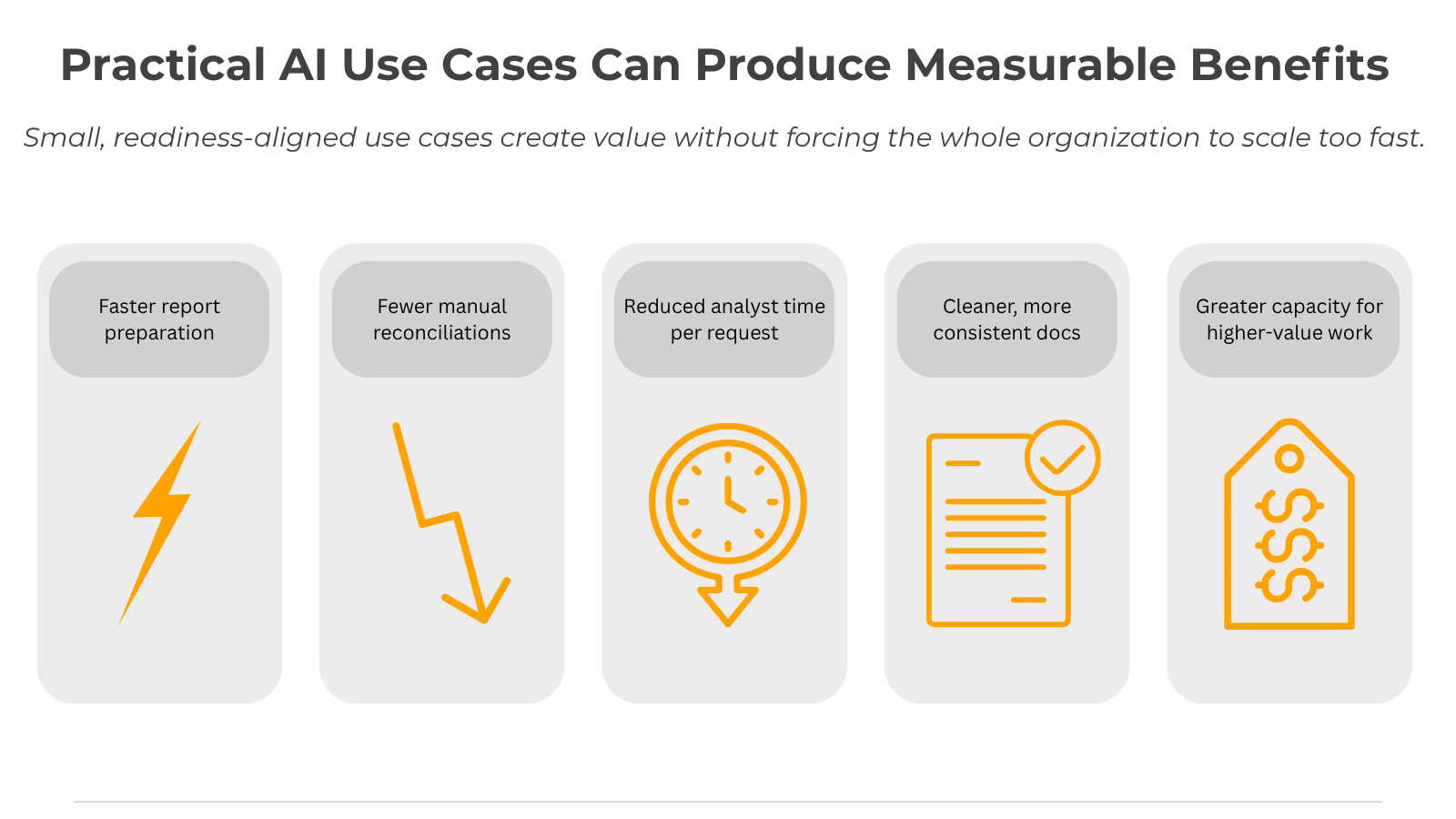
These use cases may not generate the most dramatic announcement, but they can produce measurable benefits:
✅ Faster report preparation.
✅ Fewer manual reconciliations.
✅ Reduced analyst time per request.
✅ Cleaner and more consistent documentation.
✅ Greater capacity for higher-value work.
When ownership, trust, and continuous delivery are already in place, AI becomes easier to scale.
A use case can be tied to a named business owner and measurable result. Outputs can be evaluated against metrics people already trust. Pilots can move toward production without being rebuilt from the ground up, and new use cases can reuse the same data products, governance patterns, and delivery processes.
Instead of funding a collection of disconnected experiments, the organization begins building a repeatable capability.
That is the difference between adopting an AI tool and becoming good at using AI.
A practical sequence might look like this:
Start with a specific workflow, decision, or bottleneck where AI could reduce effort or improve speed. Define the result you want before selecting the technology.
Name the accountable business owner and confirm that the relevant definitions, sources, lineage, quality expectations, and access controls are understood well enough to support the use case.
Begin with a bounded application where outputs can be reviewed and measured. Keep human judgment involved when the cost of a wrong result is significant.
Track whether the use case actually saves time, improves quality, earns adoption, or creates business value. Use feedback to improve the workflow, data, model, and controls.
Once the pattern works, reuse trusted data products, governance approaches, monitoring, and delivery processes across additional use cases.
This sequence allows organizations to learn quickly without confusing urgency with readiness.
Business-first investment — AI is tied to measurable leverage rather than technology hype.
Clear accountability — every use case has an owner responsible for its outcome.
Trusted decision data — outputs are grounded in definitions and metrics the business understands.
Controlled experimentation — teams can learn without introducing unnecessary operational risk.
Continuous delivery — useful pilots can evolve into dependable, scalable capabilities.
This approach works because each AI investment is anchored to something the organization already understands: a business need, an accountable owner, trusted decision data, and a controlled way to learn.
Experimentation still happens, but it happens within boundaries. Teams can move quickly without treating every pilot as production-ready, and successful use cases have a clearer path toward becoming reliable capabilities.
The result is not slower AI adoption. It is adoption that compounds instead of repeatedly starting over.
AI and analytics do not fix weak systems. They expose them—and often amplify them.
But that is not a reason to avoid AI.
It is a reason to prepare for it deliberately.
Organizations do not need perfection before they begin. They need enough ownership, trust, and delivery capability to ensure that each investment produces learning, measurable value, and a stronger foundation for what comes next.
Start with practical leverage.
Build on trustworthy decision data.
Create the ability to improve continuously.
That is how AI moves from hype to capability.
Interested in preparing your organization for scalable AI and analytics?
👉 Contact NexusLeap to learn how we help teams establish accountable ownership, trusted data foundations, and continuous delivery capabilities—so technology investments create lasting business value.
Answering Commonly Asked Questions.

At NexusLeap, we’re united by a singular mission: equip our clients with decision-making analytical tools.


Facilitates seamless business operations.
Copyright © 2024 by NexusLeap, LLC.