Tutorials
January 12, 2024
Before adding another dashboard, AI layer, or analytics tool, teams need data they can trust. This article explores how clear lineage, accountable ownership, and shared definitions create stronger foundations for faster decisions, more reliable analytics, and scalable AI.
Teams often assume the next analytics problem can be solved with another dashboard, a new tool, or an AI layer.
But most analytics problems start earlier than the dashboard.
When teams cannot trace where a metric came from, agree on what it means, or identify who owns it, adding more technology usually creates more chaos—not more clarity.
Before scaling dashboards, AI, or analytics tools, organizations need a trusted data foundation.
A new dashboard may improve how information is displayed, but it cannot repair unclear inputs.
Without strong foundations:
The result is often a growing library of reports that still cannot answer basic business questions with confidence.
The problem is not always the dashboard.
The problem is whether the data underneath it can be trusted.
Before adding another analytics layer, ask:
If those answers are unclear, the organization may not need another dashboard yet.
It may need stronger foundations.
Strong data foundations make dashboards usable in the first place.
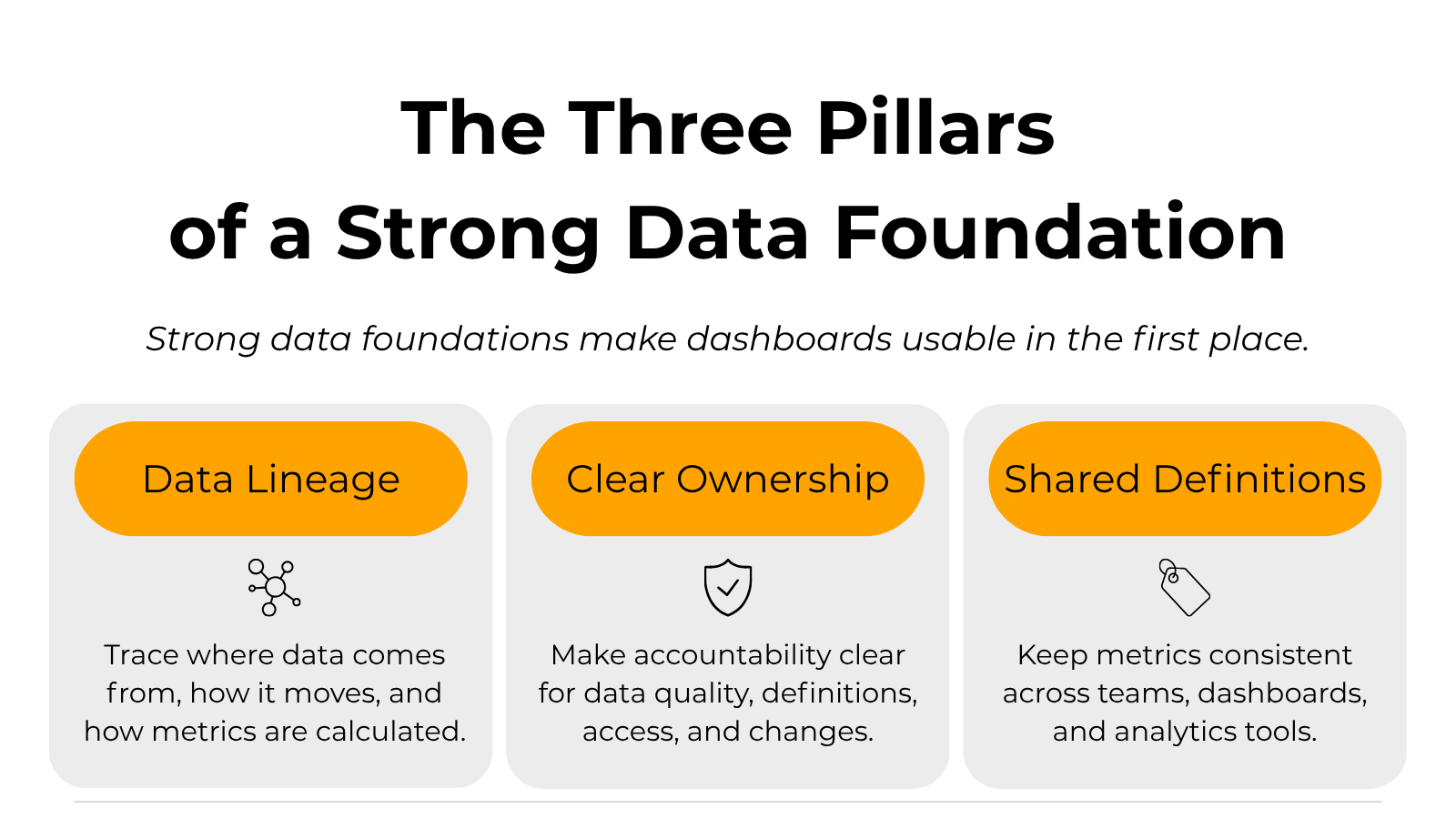
At NexusLeap, we often think about those foundations through three core pillars:
Data lineage explains where information originates, how it moves through the system, and how metrics are calculated from beginning to end.
A strong lineage process helps teams answer:
Without lineage, every investigation becomes data archaeology.
With lineage, teams can trace the number, understand the logic, and resolve issues faster.
Strong data systems have clearly identified owners.
Someone should be accountable for:
Ownership does not mean one person handles every technical task.
It means questions have a responsible decisionmaker instead of disappearing into a long email chain or Slack thread.
When ownership is clear, teams know where to go for answers, how decisions are made, and who is responsible for maintaining trust.
A metric should mean the same thing across teams, tools, and conversations.
Terms like revenue, active customer, retention, order volume, or conversion rate may sound straightforward, but different groups often calculate them differently.
Shared definitions reduce that ambiguity.
They establish:
When definitions are shared, teams spend less time debating the number and more time acting on it.
It is tempting to think that more technology will make analytics faster.
But weak foundations often create the opposite effect.
When trust is missing:
The organization may appear to be scaling analytics, while the actual decision-making process becomes slower and more fragmented.
AI does not remove the need for trusted data.
It increases it.
An AI assistant, semantic layer, or natural-language analytics tool still depends on accurate inputs, clear definitions, and reliable ownership.
If the underlying data is inconsistent, AI may produce confident answers that are technically derived but operationally wrong.
Before asking AI to interpret the business, organizations need confidence that:
AI can accelerate analysis, but it cannot create trust from broken foundations.
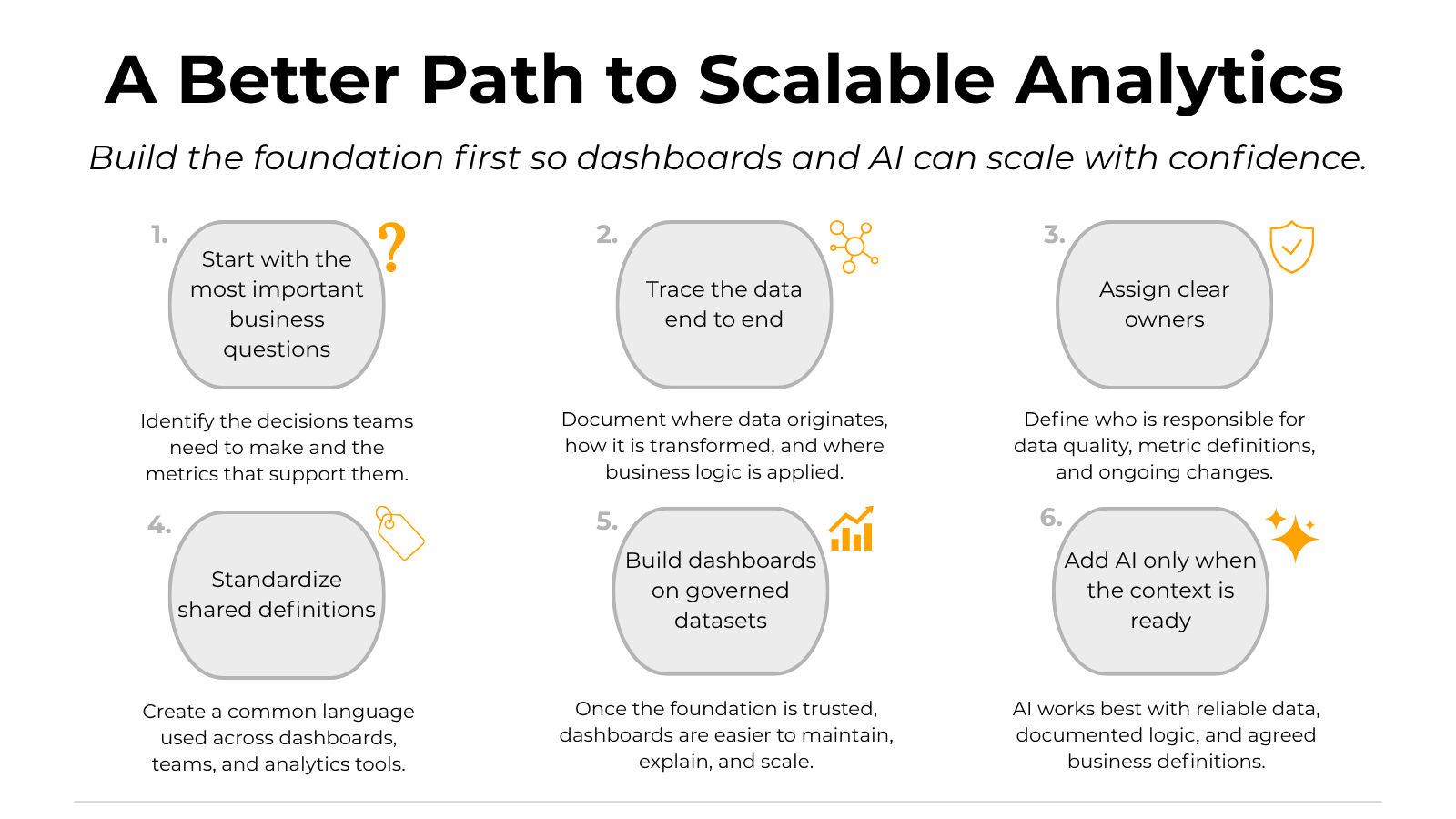
Organizations do not need to solve every governance problem before delivering value. The goal is to establish enough structure that analytics can grow without multiplying confusion.
A practical approach is to:
Identify the decisions teams need to make and the metrics that support those decisions.
Document where the data originates, how it is transformed, and where business logic is applied.
Define who is responsible for data quality, metric definitions, and ongoing changes.
Create a common language that is reused across dashboards, teams, and analytics tools.
Once the foundation is trusted, dashboards become easier to maintain, explain, and scale.
AI becomes much more useful when it operates on reliable data, documented logic, and agreed business definitions.
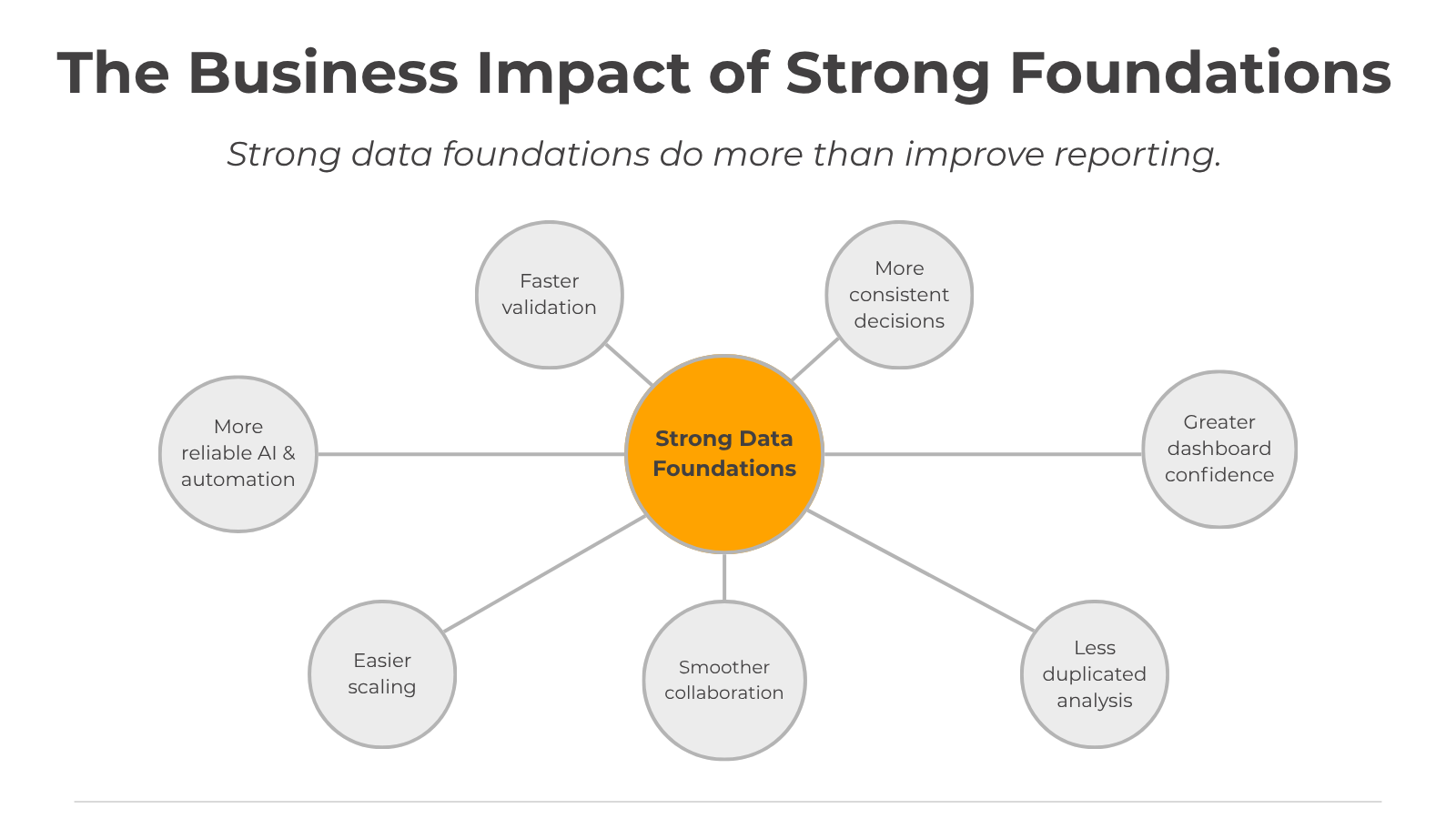
They create:
The biggest benefit is trust.
When people understand where a number comes from, what it means, and who owns it, analytics becomes part of the decision-making process instead of another source of debate.
Before adding another dashboard, AI model, or analytics tool, look at the foundations first.
Strong analytics depends on three things:
Get those right, and dashboards become more usable, decisions become more confident, and analytics becomes easier to scale.
The best analytics platforms are not built by stacking more tools on top of unclear data.
They are built by creating clarity, ownership, and trust from the ground up.
Interested in strengthening your organization’s data foundation before scaling dashboards or AI?
👉 Contact NexusLeap to learn how we help teams establish trusted data models, shared definitions, and scalable analytics systems.
Answering Commonly Asked Questions.

At NexusLeap, we’re united by a singular mission: equip our clients with decision-making analytical tools.


Facilitates seamless business operations.
Copyright © 2024 by NexusLeap, LLC.